Betting systems choose your stake; playing strategies choose your action. Combine one of each in Simulation. These presets do not count cards or establish an advantage. Pros describe useful comparisons, not promises of profit.
Bet sizing · Established baseline
How it works
Wager one base unit every round.
Example: With a $10 unit: $10, $10, $10, regardless of results.
Pros
A consistent stake makes hand strategies easier to compare.
Cons
Losses still accumulate; a fixed stake does not create an advantage.
Research source · Reviewed 26 October 2026. Source results for other rules are not predictions for this simulator.
Try Flat bet
Bet sizing · Established progression
How it works
Double the previous opening bet after a net loss; reset to one unit after a net profit. Hold after break-even.
Example: With a $10 unit, loss → loss → profit gives next bets $20 → $40 → $10.
Pros
Simple rules; short losing sequences can be followed by recovery.
Cons
Stakes grow rapidly. Limits, split losses and partial payouts defeat the idea of guaranteed recovery.
Research source · Reviewed 26 October 2026. Source results for other rules are not predictions for this simulator.
Try Martingale
Bet sizing · Adapted positive progression
How it works
Double after profit. Reset after a loss or three profitable rounds in the cycle; break-even pauses the cycle. The three-win reset is our chosen variant.
Example: Three profits with a $10 unit: wager $10, $20, $40, then restart at $10.
Pros
Losses reset the stake instead of escalating it.
Cons
A later loss can consume earlier gains; winning sequences are unpredictable.
Research source · Reviewed 26 October 2026. Source results for other rules are not predictions for this simulator.
Try Paroli · three wins
Bet sizing · Established progression
How it works
Add one base unit after a loss; subtract one after profit, with a minimum of one unit. Hold after break-even.
Example: With a $10 unit, loss → loss → profit gives next bets $20 → $30 → $20.
Pros
Stakes rise more slowly than doubling.
Cons
Still increases exposure after losses; a long deficit can exhaust the bankroll.
Research source · Reviewed 26 October 2026. Source results for other rules are not predictions for this simulator.
Try D’Alembert
Bet sizing · Adapted negative progression
How it works
Use 1, 1, 2, 3, 5, 8… units, starting at the second 1. Move forward one place after loss and back two after profit. Moving before the first entry restarts at the second 1; break-even holds.
Example: From the second 1: loss → loss → profit gives next stakes 2 → 3 → 1 units.
Pros
A defined sequence makes loss escalation easy to inspect.
Cons
Later stakes become large. Recovery arguments for even-money bets do not transfer directly to blackjack.
Research source · Reviewed 26 October 2026. Source results for other rules are not predictions for this simulator.
Try Fibonacci
Bet sizing · Original experiment
How it works
Repeat 1, 2, 3, 2 base units. Advance after every round, including break-even, without looking at wins or losses.
Example: $10, $20, $30, $20, $10, $20…
Pros
Predictable exposure without chasing losses.
Cons
The pattern has no information about the shoe and wagers more than flat betting.
Created for this trainer as an experiment; not an established or validated gambling system.
Try Wave
Bet sizing · Original experiment
How it works
Repeat four one-unit bets followed by one five-unit bet. Advance after every round, including break-even.
Example: $10, $10, $10, $10, $50, then repeat.
Pros
Demonstrates how occasional larger stakes affect the result curve.
Cons
One badly timed pulse can outweigh several small wins; its timing has no predictive value.
Created for this trainer as an experiment; not an established or validated gambling system.
Try Pulse
Hand decisions · Trainer baseline
How it works
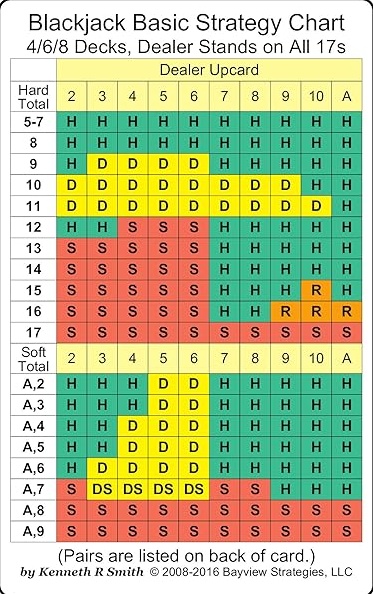
Use the same hard-total, soft-total and pair recommendations as Practice, subject to legal actions and affordability.
Example: Hard 16 against dealer 10: surrender on the original two-card hand, otherwise hit.
Pros
Uses the dealer upcard and available actions.
Cons
Fixed trainer recommendations are not a deck-composition model and do not guarantee profit.
Research source · Reviewed 26 October 2026. Source results for other rules are not predictions for this simulator.
Try Trainer basic strategy
Hand decisions · Known poor strategy
How it works
Hit below 17 and stand at 17 or higher, including soft 17. Never double, split or surrender.
Example: Stand on soft 17 even against dealer 10.
Pros
Easy comparison that isolates the cost of ignoring player options.
Cons
Player busts lose immediately, so copying the dealer does not create symmetry.
Research source · Reviewed 26 October 2026. Source results for other rules are not predictions for this simulator.
Try Mimic the dealer
Hand decisions · Known poor strategy
How it works
Use basic strategy, but replace any recommended hit on a hard total of 12 or more with stand. Keep other recommended actions.
Example: Hard 16 against 10 stands if surrender is unavailable.
Pros
Avoids busts caused by hitting hard 12 or higher.
Cons
Standing on weak totals sacrifices opportunities to improve. Doubles can still bust.
Research source · Reviewed 26 October 2026. Source results for other rules are not predictions for this simulator.
Try Never bust
Hand decisions · Original experiment
How it works
Hit everything below 20 and stand on 20 or 21. Never double, split or surrender.
Example: Hit hard 19, regardless of the dealer upcard.
Pros
A deliberately extreme way to explore the tradeoff between improvement and busting.
Cons
Throws away strong hands by repeatedly risking a bust. Not recommended play.
Created for this trainer as an experiment; not an established or validated gambling system.
Try Chase 20
Hand decisions · Original experiment
How it works
Split every matching-value pair when legal and affordable, including tens and fives. Otherwise use basic strategy.
Example: Two tens split against any dealer upcard, up to four hands.
Pros
Highlights how splitting changes total exposure and hand count.
Cons
Breaks up strong totals and spends more on unfavorable splits. Not recommended play.
Created for this trainer as an experiment; not an established or validated gambling system.
Try Split party
Choosing a preset keeps your other settings and custom decisions. Custom decisions take priority; use Reset to basic strategy to clear them and restore the basic playing preset. Insurance is controlled separately. An unavailable custom action falls back to the selected playing preset.